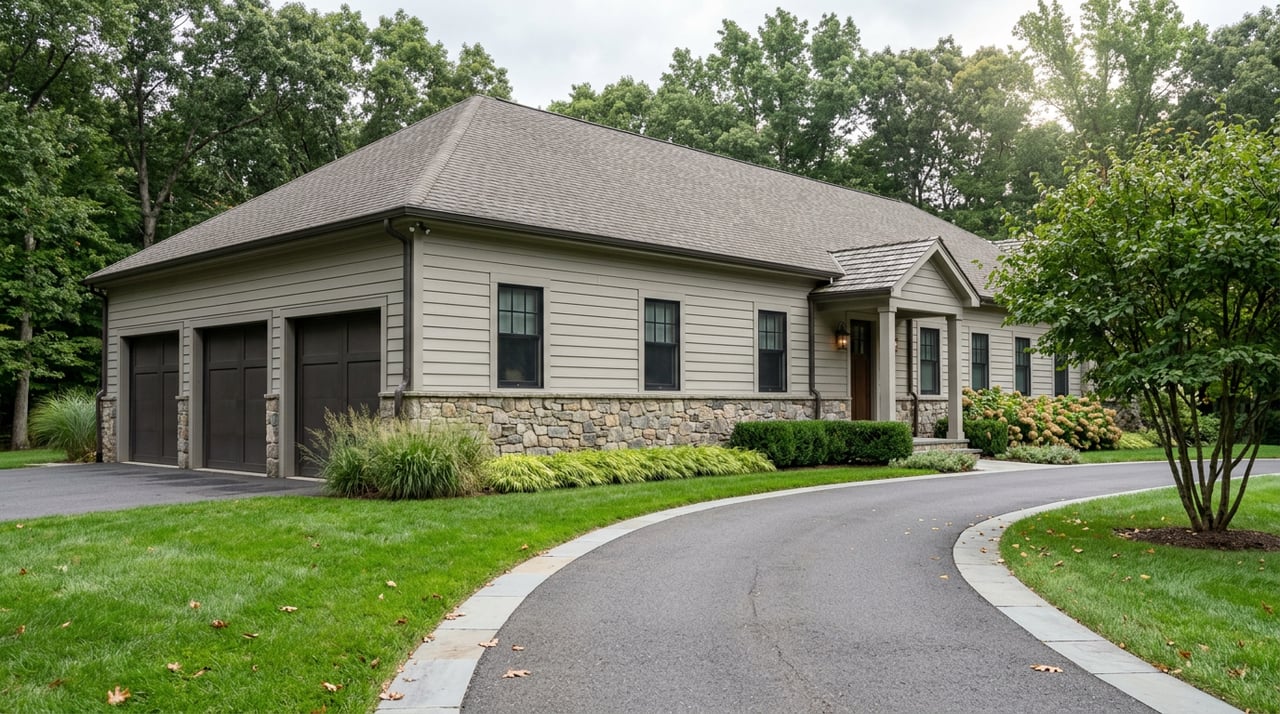
Walk the cul-de-sacs at Saucon Overlook and you'll notice something a listing sheet won't tell you outright. Lot 13 sits in the Saucon Valley School District. Lot 7, a few hundred feet away in the same 50-plus acre enclave, sits in Southern Lehigh. Each of the sixteen homesites here carries public water, but the sewer is not shared infrastructure. Every lot has its own individually approved on-site septic system, tested and signed off one parcel at a time.
That detail matters more than it sounds like it should, and it's the reason to look past this year's Lehigh Valley headlines before deciding what Saucon Valley land is actually worth right now.
The demand story everyone already knows
Eli Lilly's announcement in January 2026 was hard to miss. The pharmaceutical company committed $3.5 billion to a 925,000-square-foot manufacturing campus in Upper Macungie Township, chosen from more than 300 competing sites nationwide. The plant is expected to bring 850 permanent jobs averaging roughly $100,000 a year, with construction slated for 2026 and operations targeted for 2031.
Real estate coverage across the region moved fast on the implications. A WFMZ report from February 2026 noted the Lehigh Valley's median home sales price already sitting around $370,000, with only 535 active listings across the region at the time. Allentown's median list price had climbed more than 12 percent over two years by that point, while Bethlehem and Easton had actually seen home prices fall in recent years, a reminder that "the Lehigh Valley" was never one uniform market to begin with.
That's the version of the story a national headline tells. It treats "the Lehigh Valley" as one market absorbing one shock. Saucon Valley isn't that market, and the reason has nothing to do with school ratings or zip code prestige. It has to do with dirt.
Why a production subdivision can grow and a septic lot can't
Most of the housing stock responding to Lilly-driven demand sits on municipal sewer, in subdivisions platted for density. A builder there can add units in phases as buyers show up, because the infrastructure underneath the ground was engineered to scale.
Saucon Valley's premium inventory works differently. Large-lot, septic-dependent land doesn't expand by simply pouring more concrete. Every homesite needs its own percolation test, its own township approval, its own confirmation that the soil can handle a private system at that specific spot. You can't retrofit that process to move faster just because demand across the region is rising.
What governs supply | Production-built subdivisions | Septic-dependent estate lots |
|---|---|---|
Sewer | Shared municipal system | Individual on-site septic per lot |
Approval pace | Phased by builder schedule | Perc test and township sign-off per parcel |
Response to demand spike | Can add units in months | Bottlenecked by soil and lot-by-lot approval |
Practical ceiling | Set by zoning density | Set by how many parcels can actually perc |
This is why Saucon Overlook, a subdivision most buyers outside the immediate area have never heard of, is worth paying attention to. Seven of its sixteen lots have already sold. That's not a coincidence of good marketing. It's what a market with a hard supply ceiling looks like when even modest demand shows up. The lots run from about two acres up to nearly three, each marketed on the panoramic Lehigh Valley views the development was built around, and a sellout pace of nearly half the enclave tells you the ceiling is already being tested.
The two-school-district wrinkle isn't a fluke
The fact that Saucon Overlook straddles both Saucon Valley and Southern Lehigh school districts within a single subdivision isn't an oddity of this one project. It's a symptom of how Saucon Valley land actually gets carved up. Township and school district lines here don't follow tidy subdivision boundaries. They follow old property lines, township borders drawn generations before anyone platted a cul-de-sac.
For a buyer comparing two lots that look identical on a site plan, that line can mean a genuinely different school assignment, a different tax jurisdiction, and in some cases a different set of building requirements depending on which side of the boundary the parcel falls. It's the kind of friction that never shows up in a median price and rarely gets asked about until a buyer is already deep into due diligence on a specific lot.
What's happening on the resale side tells the same story
Look at the custom estate listings moving through Lower and Upper Saucon Township this year and the pattern holds. Properties on nine-plus acres, six-plus acres, and multi-acre parcels along quiet country roads keep showing up as the premium end of the market, often described with language about privacy and long driveways rather than proximity to anything. These aren't spec-built homes competing on square footage. They're custom estates on land that, once built, can't be subdivided or densified without running back through the same septic and approval gauntlet that slowed Saucon Overlook's rollout in the first place.
Meanwhile, a different kind of housing growth is happening in the same footprint. Communities like Traditions of America at Saucon Valley, Four Seasons of Saucon Valley, and The Cottages at Old Saucon have added active adult, low-maintenance housing stock over recent years, some of it with direct views of Saucon Valley Country Club's fairways. That's real supply growth. It just isn't happening in the large-lot custom estate segment, because those communities were built within already-platted infrastructure rather than carved fresh from raw acreage.
The takeaway for a buyer comparing neighborhoods on price alone: Saucon Valley's overall housing stock is not static, but its estate-lot segment specifically is capped in a way that has nothing to do with how much demand Eli Lilly's plant sends this direction over the next five years.
What this means if you're comparing Saucon Valley to other options
If you're weighing Saucon Valley against other parts of the Lehigh Valley on the strength of a regional headline, the honest answer is that the headline doesn't apply evenly. A production-built neighborhood in Upper Macungie or a revitalizing block in Easton can add inventory as workers arrive. A two-acre parcel in Saucon Valley with an unproven septic site can sit for months waiting on a perc test regardless of how many resumes are landing in Fogelsville.
That asymmetry is the reason estate land here tends to hold its value differently than the regional median suggests, and it's also the reason a buyer touring any large lot in this area should be asking pointed questions before falling for a view. Has the septic actually been tested and approved, or only proposed. Which school district does this specific parcel fall in, not the subdivision as a whole. And how many more homesites could the township realistically approve nearby, given what the soil and the road frontage will support.
None of this is a reason to avoid Saucon Valley. It's a reason to understand what you're actually buying when you buy land here, and why a scarce, half-sold sixteen-lot subdivision is a better read on the market than a median price pulled from a region that includes a very different kind of supply.
If you're comparing Saucon Valley to other Lehigh Valley and Upper Bucks County submarkets and want the lot-by-lot detail that doesn't show up in a portal listing, The Rebecca Francis Team can walk you through what's actually available and what it would take to build on it. Request a private consultation before you fall in love with a view that hasn't cleared its perc test yet.
FAQ
Does buying a lot in a subdivision like Saucon Overlook guarantee which school district my children will attend? No. Within a single subdivision, individual lots can fall in different school districts depending on where township and district lines run. Confirm the district for the specific parcel, not the development's general marketing.
Will the Eli Lilly plant directly raise home values in Saucon Valley? The plant is expected to increase regional housing demand broadly, with construction slated for 2026 and operations targeted for 2031. Saucon Valley's large-lot estate segment is likely to be affected differently than production-built neighborhoods closer to Upper Macungie Township, given how much slower septic-dependent land can respond to new demand.
Are there other similar raw-land opportunities in Saucon Valley right now? Available acreage does surface periodically in Lower and Upper Saucon Township, often as individual estate parcels rather than platted subdivisions. Each comes with its own septic and approval timeline, so treat every listing as its own case rather than assuming similar terms to Saucon Overlook.